Slate Roofing in Dallas: Premium Natural Stone and Alternative Options
Expert slate roofing installation for Highland Park, Lakewood, and historic Dallas homes
Slate roofs appear throughout Highland Park and Lakewood on historic homes[5]. We've worked with slate roofing across Dallas. The material lasts longer than any other roofing option[2]. We install natural stone slate and synthetic alternatives. Our team inspects your home's structure first. Not every house can support natural slate, and we explain why upfront.
What is slate roofing in Dallas?
Slate roofing uses stone tiles on your roof. You can pick real stone from a quarry or synthetic tiles that look like stone. Both types resist fire and last a very long time.
The weight difference matters:
Real slate weighs 800-1,500 pounds per square. Asphalt shingles weigh only 250 pounds. Your roof frame must be strong enough to hold slate.
What slate provides:
- Lasts 75-150 years (longer than you'll own the home)
- Won't catch fire (Class A fire rating)
- Needs strong roof beams underneath
- Handles Dallas heat better than other materials
Real slate comes from stone quarries. Workers cut large rocks into thin tiles. Synthetic slate uses composite materials pressed into tile shapes. Both look similar from the street.
Key Point:
The weight difference between slate and asphalt affects your entire roof structure. We measure your roof beams before recommending real slate.
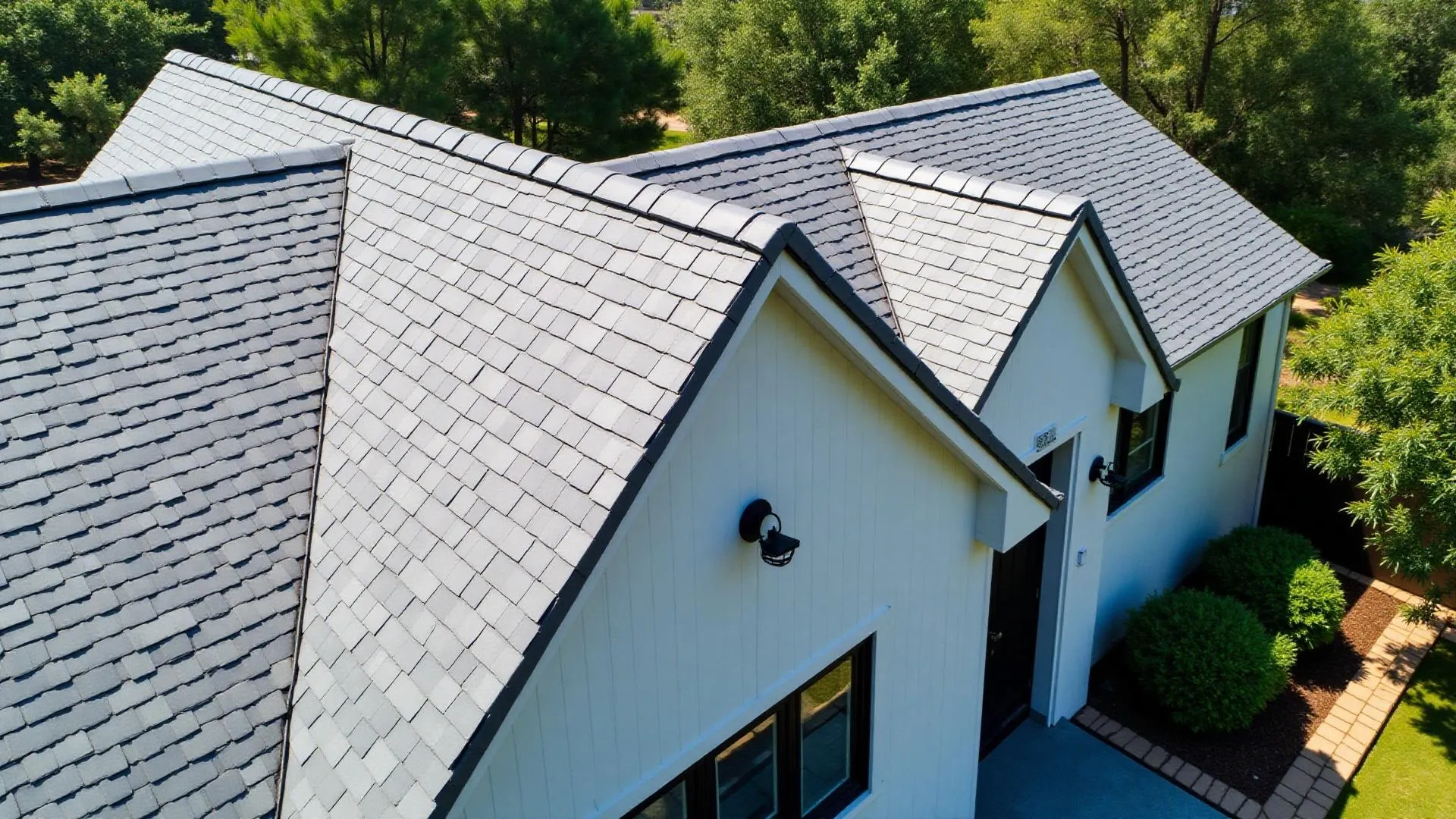
Natural slate roofing tiles close-up in Dallas
Natural Slate Roofs Last 75 to 150 Years in Dallas
Natural slate outlasts asphalt shingles by 50-125 years[2]. Historic homes in Lakewood and Highland Park often have original 1920s slate roofs still performing well[5]. The longevity makes slate a one-time investment for multiple generations.
| Roof Type | Years It Lasts | Replacement Frequency |
|---|---|---|
| Natural Slate | 75-150 years | Once per century |
| Synthetic Slate | 30-50 years | Once per generation |
| Asphalt Shingles | 15-20 years | Every 15-20 years |
Dallas heat wears down asphalt shingles faster than in cooler climates. Summer temperatures reach 100+ degrees regularly. The sun's UV rays break down petroleum-based shingles. Colors fade to washed-out gray within 10 years.
Stone resists thermal breakdown and UV damage. Natural slate maintains color and structural integrity through decades of intense Texas summers.
Structural requirements:
Homes built before 1950 in established Dallas neighborhoods often have adequate framing for slate. Post-1950 construction typically used lighter framing designed for asphalt shingles[3]. We verify structural capacity before recommending natural slate. Some homes need frame upgrades to support the weight safely.
Slate material comparison - natural vs synthetic
Slate Roofing Materials Include Natural Stone and Synthetic Alternatives
Synthetic slate weighs 60-80% less than natural stone while providing similar visual appeal. The material delivers 30-50 year lifespan without extreme weight.
| Feature | Real Slate | Synthetic Slate | Asphalt Shingles |
|---|---|---|---|
| Weight | 800-1,500 lbs/sq | 300-450 lbs/sq | 200-250 lbs/sq |
| Lifespan | 75-150 years | 30-50 years | 15-25 years |
| Cost | Highest | Medium | Lowest |
| Frame Requirements | Often needs upgrades | Usually works as-is | Standard framing |
| Dallas Performance | Excellent heat/UV resistance | Good heat resistance | Degrades in 10-15 years |
Dallas building codes require structural load calculations for natural slate installation. Engineers must verify your existing framing can handle the weight or design necessary reinforcement.
Synthetic materials often fit existing framing in homes built after 1950. You get slate appearance without structural upgrade costs.
Cost analysis:
Natural slate costs more upfront but lasts 75-150 years. Divide the cost over the lifespan for accurate comparison. Synthetic slate costs less initially while still outperforming asphalt significantly.
Value Consideration:
If your home needs $30,000 in structural reinforcement for natural slate, synthetic slate might save $40,000 in total project costs while still providing 30-50 years of service.
Professional Installation Prevents Structural Damage and Material Waste
Slate breaks easily under improper handling. Standard roofing tools and techniques don't work. Each tile requires careful cutting, drilling, and fastening to prevent cracking.
Proper installation requirements:
- ✓ Copper or stainless steel nails (galvanized corrodes in 10-15 years)
- ✓ Pre-drilled holes positioned precisely
- ✓ Correct overlap patterns for water shedding
- ✓ Ice and water shield underlayment in valleys and eaves
- ✓ Two fasteners per tile at specific locations
Texas wind loads during severe storms require proper fastening patterns. We follow National Roofing Contractors Association standards for slate installation. Each tile gets two fasteners positioned to resist wind uplift forces of 60+ mph.
Installation Note:
Slate installation takes 5-10 days for an average residential roof. Asphalt takes 1-2 days. The time difference reflects the precision required. Contractors who promise fast slate installation typically lack proper training.
Fastener selection matters:
Standard galvanized nails corrode in Dallas humidity within 10-15 years. Your 100-year slate roof fails due to $50 worth of inappropriate fasteners. We use only copper or stainless steel slating nails that last as long as the stone.
Common installation failures:
- • Cracked tiles from excessive drilling pressure
- • Water leaks from incorrect overlap patterns
- • Wind damage from improper fastener placement
- • Premature failure from using standard roofing nails
Most Dallas roofing contractors avoid slate work because it requires specialized skills and equipment. The learning curve is steep and mistakes are expensive.
Professional slate roofing installation in progress
Slate Colors and Styles Match Historic Dallas Architecture
Natural slate ranges from gray, green, purple, red, and black tones depending on quarry source and mineral content. Synthetic versions replicate these historical colors.
| Color | Best Applications | Popularity |
|---|---|---|
| Gray | Any brick color | Most popular - works with everything |
| Green | Tudor, Colonial homes | Common in 1920s-1930s construction |
| Multi-color | Varied exteriors | Creates old-world appearance |
| Black | Light-colored homes | Bold, dramatic contrast |
| Red/Purple | Victorian, Gothic Revival | Period-specific applications |
Dallas historic districts regulate roofing materials and colors[5]. Swiss Avenue, Munger Place, and designated Lakewood areas require Certificate of Appropriateness approval before starting work.
The City of Dallas Landmark Commission reviews:
- • Material type (natural vs. synthetic)
- • Color selection
- • Installation methods
- • Historical accuracy for restoration projects
Historic District Process:
Certificate of Appropriateness applications require material samples, installation specifications, and color documentation. Processing can take 4-6 weeks. We handle this paperwork regularly.
Synthetic vs. natural appearance:
Synthetic slate has improved significantly in the last decade. From street level, quality synthetic products look authentic. Close inspection reveals differences. Natural slate has color variation within individual tiles. Synthetic slate tends toward uniform coloring.
For most applications, synthetic slate performs well. For high-end historic restorations in designated districts, natural slate remains the preferred material.
Heat absorption factor:
Darker slate colors absorb more heat than lighter colors. This affects attic temperatures and cooling loads during Dallas summers. Light gray reflects more solar energy than black slate. The difference is measurable in attic temperature readings.
Proper Roof Deck Preparation Supports Heavy Slate Weight
Structural assessment is mandatory before natural slate installation[3]. Engineers verify existing roof framing capacity or design necessary reinforcement. Failures occur when contractors skip this step.
The 800-1,500 pounds per square load concentrates at fastener points and tile overlaps. Loads aren't distributed evenly across the roof surface.
Structural preparation steps:
- Step 1: Licensed structural engineer evaluates existing framing
- Step 2: Load calculations compare current capacity to slate requirements
- Step 3: Engineer designs reinforcement plan if needed
- Step 4: Reinforce rafters or trusses to meet specifications
- Step 5: Upgrade roof decking if damaged or insufficient thickness
- Step 6: Obtain building permit and schedule inspections
- Step 7: Install slate only after structural approval
Frame Requirements:
Most post-1950 Dallas homes have 2x4 or 2x6 rafters at 24-inch spacing. Natural slate typically requires 2x6 minimum at 16-inch spacing or engineered reinforcement. Specific requirements depend on roof pitch, span, and wind exposure.
Pre-1950 construction:
Many older Dallas homes in Highland Park, Lakewood, and Swiss Avenue were built with heavier framing when slate was common. These homes often support natural slate without major upgrades. Inspection still verifies current condition and identifies any deterioration.
Synthetic slate advantage:
Most existing roof frames handle synthetic slate without reinforcement. We still inspect roof decking for water damage, rot, or structural deficiencies. New roofing over compromised decking leads to problems regardless of material weight.
Cost vs. safety balance:
Structural reinforcement represents one-time upfront cost that ensures roof safety. We follow engineering specifications on every installation. Zero structural failures have occurred on our properly engineered slate installations.
Professional Standard:
We don't install slate on homes with inadequate structural capacity, even if customers request it. Safety and building code compliance[3] aren't negotiable.
Frequently Asked Questions About Slate Roofing in Dallas
How long does slate roofing last in Dallas weather?
Natural slate lasts 75-150 years in Dallas conditions. Synthetic slate provides 30-50 years of service. Both exceed asphalt shingle lifespan significantly.
| Weather Type | Impact on Slate | Impact on Asphalt |
|---|---|---|
| 105°+ Summer Heat | No degradation | Accelerated breakdown |
| Intense UV Exposure | Stone unaffected | Fading in 10 years |
| Hail Storms | Resistant to all but largest hail | Significant damage |
| High Winds | Proper installation resists 60+ mph | Edge lifting, blow-offs |
Natural stone was formed under extreme underground heat and pressure over millions of years. Roof surface conditions don't approach those formation conditions. The material remains stable through decades of exposure.
Hail resistance:
Natural slate resists hail impact due to stone density and strength. Small to medium hail (under 1.5 inches) typically causes no damage. Large hail (2+ inches) may crack individual tiles on direct impact. Synthetic slate performs better than asphalt but not as well as natural stone.
Do Highland Park homes need structural reinforcement for slate roofs?
Most Highland Park homes built before 1950 have adequate framing for natural slate. These properties were constructed when slate was a common roofing material. Inspection verifies current framing condition and load capacity.
What engineers evaluate:
- ✓ Rafter or truss size and spacing
- ✓ Current condition (no rot or damage)
- ✓ Load path to exterior walls
- ✓ Previous modifications affecting structure
- ✓ Roof pitch and span distances
Homes with original slate that was later replaced with asphalt typically retained heavy-duty framing. Installing slate returns the roof to original design specifications.
Post-1950 Highland Park construction varies by builder. Some used substantial framing. Others built to minimum code for lighter shingles. We can't assume capacity without professional inspection and engineering calculations.
Inspection Process:
Engineering evaluation costs $500-$1,000. The investment prevents expensive structural problems and ensures safe installation.
What slate roofing colors work best in Dallas neighborhoods?
Gray and green slate complement red brick that dominates Dallas residential architecture. Gray slate accounts for 60%+ of our installations because it works with virtually any exterior color.
| Home Style | Recommended Colors | Rationale |
|---|---|---|
| Tudor | Green, gray-green | Historically authentic |
| Colonial Revival | Gray | Traditional period choice |
| Mediterranean/Spanish | Red, multi-color | Complements tile and stucco |
| Modern Contemporary | Black | Bold contrast |
| Victorian | Multi-color, purple | Period-appropriate |
Historic district considerations:
Dallas Landmark Commission[5] guidelines influence color selection in designated historic districts. Swiss Avenue prefers colors matching neighborhood character from early 1900s construction. Lakewood and Munger Place have specific requirements based on individual property history.
Certificate of Appropriateness applications require color samples and documentation. We maintain relationships with the Historic Preservation office and understand approval processes.
Practical considerations:
Dark colors (black, dark gray) absorb more solar heat than light colors. This affects attic temperatures during summer. The difference is 10-15 degrees in direct sun. For homes with marginal attic ventilation, color selection impacts cooling loads.
Can synthetic slate handle Dallas hail storms?
Quality synthetic slate outperforms asphalt shingles in hail resistance. Natural stone provides superior protection with Class 4 impact ratings.
| Material | Small Hail (<1") | Medium Hail (1-1.5") | Large Hail (2"+) |
|---|---|---|---|
| Natural Slate | No damage | No damage | May crack some tiles |
| Synthetic Slate | No damage | Impact marks | Cracking possible |
| Asphalt Shingles | Granule loss | Significant damage | Extensive damage |
Synthetic slate composite materials flex slightly on impact rather than shattering. This provides better performance than rigid asphalt shingles. Natural slate density and strength resist impact better than synthetic alternatives.
Insurance implications:
Class 4 impact-rated materials can reduce insurance premiums[4]. Natural slate qualifies automatically. Synthetic slate requires certification. We install only certified products meeting Texas Department of Insurance requirements.
After major hail events, slate roofs typically require spot repairs or no work. Asphalt roofs in the same storm areas often need complete replacement.
How does slate roofing installation differ from asphalt in Dallas?
Slate installation requires completely different tools, techniques, and timeline.
| Aspect | Asphalt Installation | Slate Installation |
|---|---|---|
| Cutting | Utility knife | Slate cutter, diamond blade |
| Fastening | Pneumatic nail gun | Hand nailing after pre-drilling |
| Nails | Standard galvanized | Copper or stainless slating nails |
| Speed | 1-2 days average roof | 5-10 days average roof |
| Skill Level | Entry-level acceptable | Specialized training required |
Installation process per tile:
- Step 1: Inspect tile for defects or cracks
- Step 2: Mark fastener hole locations
- Step 3: Pre-drill holes (prevents cracking)
- Step 4: Position tile with correct exposure
- Step 5: Drive copper nails by hand to proper depth
- Step 6: Verify alignment before proceeding
Each slate tile receives individual attention. We can't rush the process without causing damage.
Underlayment differences:
Slate installations use ice and water shield in valleys, eaves, and around penetrations. Felt underlayment is heavier weight (30-40 lb vs. 15 lb for asphalt). The underlayment must last decades since slate won't need replacement.
Cost structure:
Slate installation costs 3-5 times more per square than asphalt. This reflects:
- • Higher material costs
- • Specialized labor requirements
- • Extended installation timeline
- • Greater skill and precision needed
Value perspective:
Asphalt provides 15-20 years of service in Dallas. Natural slate provides 75-150 years. Synthetic slate provides 30-50 years. Cost per year of service makes slate competitive despite higher upfront investment.
Protect Your Investment with GAF Warranties
As a GAF certified contractor, we offer Golden Pledge and System Plus warranties that provide comprehensive coverage. Learn how these industry-leading warranties can protect your slate roofing investment.
Explore GAF Warranty Options →Explore Other Premium Roof Installation Options
Discover our complete range of professional roofing solutions designed for Dallas homes
Shingle Roofing
Durable and cost-effective asphalt shingle installation for residential properties
Metal Roofing
Long-lasting metal roof systems with superior weather resistance
Clay Tile Roofing
Elegant clay tile roofs with exceptional durability and timeless appeal
Flat Roof Systems
Modern flat roof solutions perfect for contemporary home designs
Ready for Premium Slate Roofing?
Contact us for a professional structural assessment and slate roofing consultation
Slate Roofing Throughout Dallas-Fort Worth
We provide slate roofing services across the DFW metroplex:
Related Services
Explore our comprehensive range of home improvement services
Residential Roofing
Complete home roofing solutions
Learn MoreCommercial Roofing
Business & industrial roofing
Learn MoreEmergency Repairs
24/7 storm damage response
Learn MoreRoof Inspections
Free professional inspections
Learn MoreMulti-Unit Residential
Apartments & condos
Learn MoreHail Damage Assessment
Insurance claim assistance
Learn More