

Tile Roofing in Farmers Branch
Repair the Damage, Not the Whole Roof
Call for a Free Estimate- GAF Certified Contractor
- BBB Accredited A+ Rating
- Family Owned and Local
Decide Between Tile Repair and Full Replacement
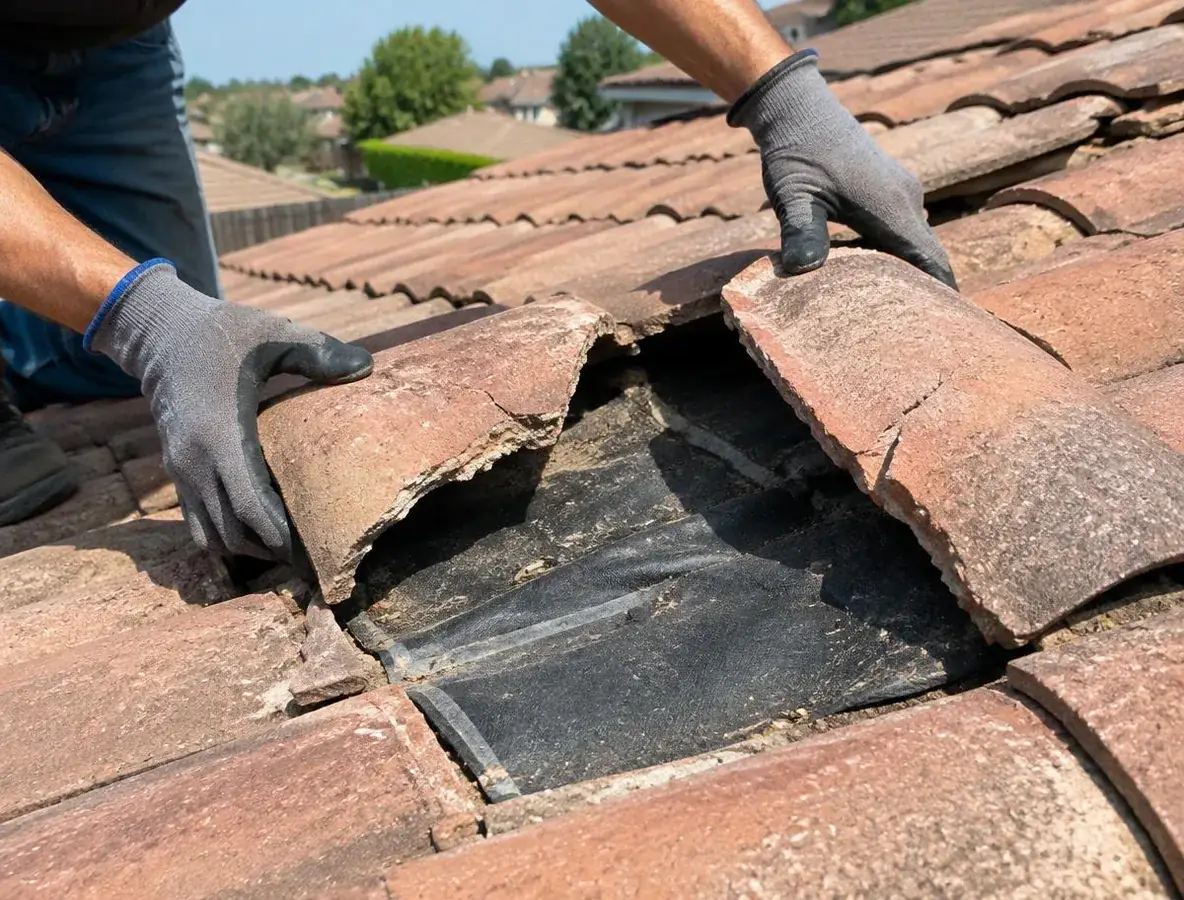
Tile itself tends to outlast the layer underneath it, so the real question is usually the condition of the underlayment, not the tile. A few cracked or slipped tiles over sound underlayment is a repair. Widespread leaks or brittle underlayment call for lifting the tile, and only badly damaged or unmatched tile means starting over with new material.
Most people with a tile roof call because they spotted something: a cracked tile after a hailstorm, a piece that slid down out of line, or a brown spot on the ceiling in a back bedroom. The tile you see is mostly there to shed water and take the sun and the hail. The underlayment beneath it is what keeps the water out of the house.
Tile is one of the materials covered by our residential roofing work in Farmers Branch and across Dallas.
That matters because those two parts wear out on different clocks. Clay and concrete tile can hold up for a long time. The underlayment under it, the felt or synthetic layer laid over the decking, tends to dry out and get brittle well before the tile does. Our North Texas summers bake it for months. So you can have a roof that looks fine from the street and is quietly letting water through underneath.
A ceiling stain doesn't tell you which one failed. It can be a cracked tile letting water reach a worn spot, or it can be the flashing at a valley or around a vent pipe. You don't know until somebody gets up there and traces it. Anybody who tells you that you need a whole new roof from the driveway is guessing.
Your choice generally falls into one of three paths.
- Repair: a handful of broken or slipped tiles, a cracked ridge piece, or one bad flashing spot, with the underlayment still holding. The broken tiles get swapped out and the problem area gets resealed. This is the right call more often than people expect.
- Lift and relay: the tile is in good shape but the underlayment is shot. The tiles come off and get stacked, new underlayment goes down, and the same tiles go back on. It keeps the look of the house and saves buying new tile.
- Full new roof: a lot of the tile is cracked or crumbling, the profile can't be matched, or you want a different material altogether. Then you're picking material, color, and profile from scratch, which is the decision the rest of this page walks through.
Matching is the part that catches people. Older tile profiles and colors get discontinued. A repair on a roof that's been up a while can mean pulling a few good tiles from a slope nobody sees, like the back side of the garage, and using them out front where it shows. The other option is new tiles that are close but not quite. If you look closely, you'll see the patch every time you pull in.
If the underlayment checks out and the damage is limited, don't let anybody talk you into a new roof. Ask whoever's quoting it to show you photos of the underlayment, not just the cracked tile on top, because that's where the real answer is.
Spot Storm Damage on a Tile Roof After Spring Hail
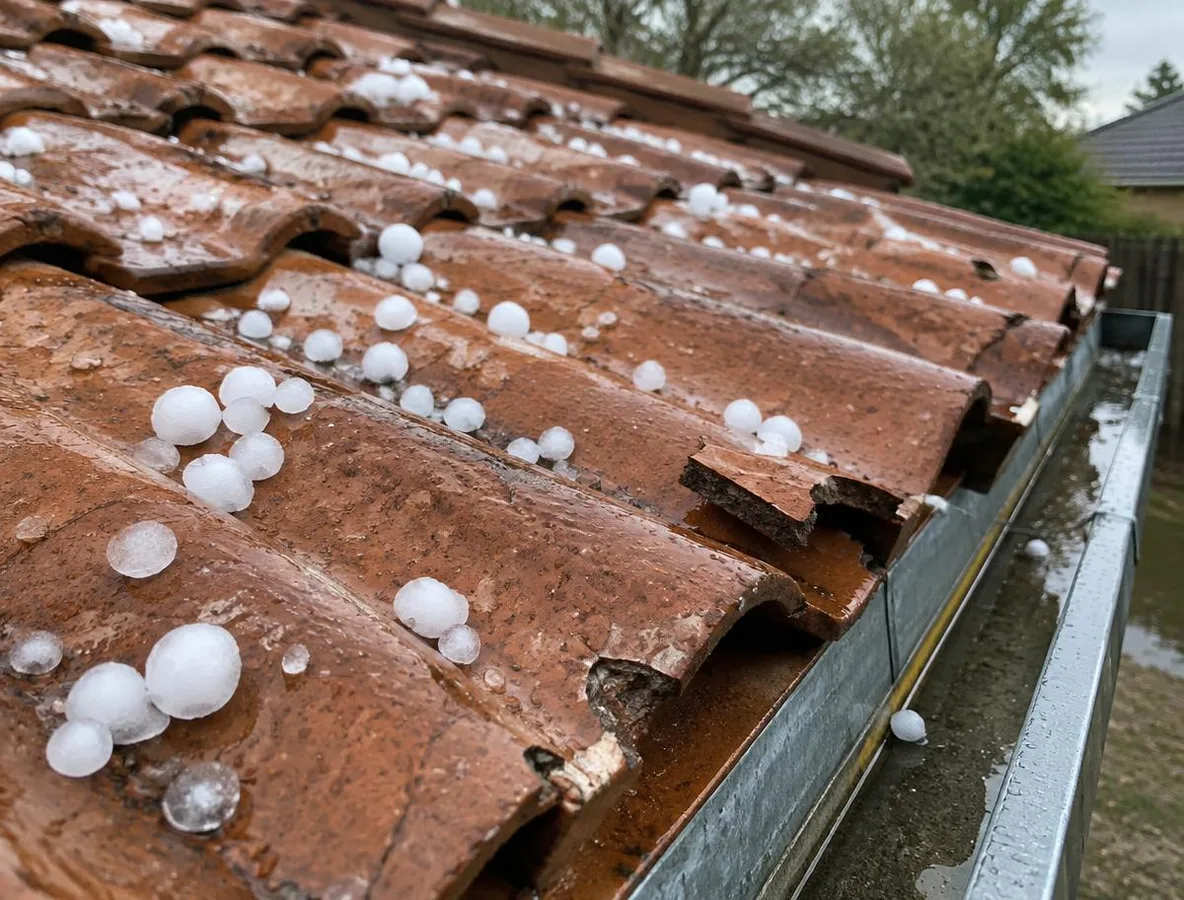
Say a hailstorm blew through Farmers Branch last night, and this morning there's ice melting in the yard and a piece of terracotta sitting in the flowerbed. Most of what you need to know about a tile roof after hail, you can figure out from the ground. Don't climb up there. Tile cracks underfoot when you don't know where to step, and a roof that took a few hits can pick up a lot more from one person walking around on it.
Walk the whole house, front and back, and look for these:
- Pieces of tile in the gutters, on the driveway, or in the beds along the foundation. Even small chips mean something up there got hit.
- Tiles that look darker or out of line with the row next to them. That can be a crack, or it can be a tile that slipped down.
- Broken or shifted ridge and hip pieces. Those are the tiles running along the peaks and the edges where two slopes meet, and they sit up high and take the brunt of it.
- On concrete tile, pale spots where the colored surface chipped off and you can see the gray aggregate underneath.
- Dents in the gutters, the downspouts, the metal roof vents, or the fins on your AC unit. Those don't hurt the roof directly, but they tell you how big the hail was and which way it came from.
Clay and concrete tile don't break the same way. Clay tends to crack clean through or shatter at the corner, so it's usually easier to spot. Concrete is heavier and more likely to chip or bruise. A bruised concrete tile can look fine from the yard and still have a hairline crack you'll only find up close.
A crack you find doesn't always mean this storm caused it. It can be fresh hail damage, or it can be an old crack from somebody walking the roof years ago to service a vent or a satellite dish. You don't know which until somebody gets up there and looks at the edges of the break. Fresh breaks tend to look clean and bright inside, and old ones tend to be dirty and weathered. That difference matters if you're filing a claim, because the adjuster is going to ask the same question.
So before anybody touches the roof, take pictures. Shoot the tile pieces where they landed, the dented gutters, the AC fins, and any ceiling spots inside, and note the date and time of the storm. Phone photos are fine. If tiles get swept up or replaced before they're documented, that record is gone.
Wind does its own kind of damage, and it's quieter. You won't see ice in the yard, just a tile or two lifted at the edge of a slope or a ridge piece sitting crooked. Once a tile is loose, the next storm can get under it a lot easier.
What you find from the ground tells you whether you need a closer look. It won't tell you whether it's a repair or something bigger, because that comes back to the underlayment check covered above. If you spot damage, we can get up there, document it slope by slope, and meet your adjuster if it turns into a claim.
Have questions? We're happy to help.
(214) 649-5984Work With Insurance on a Tile Roof Claim
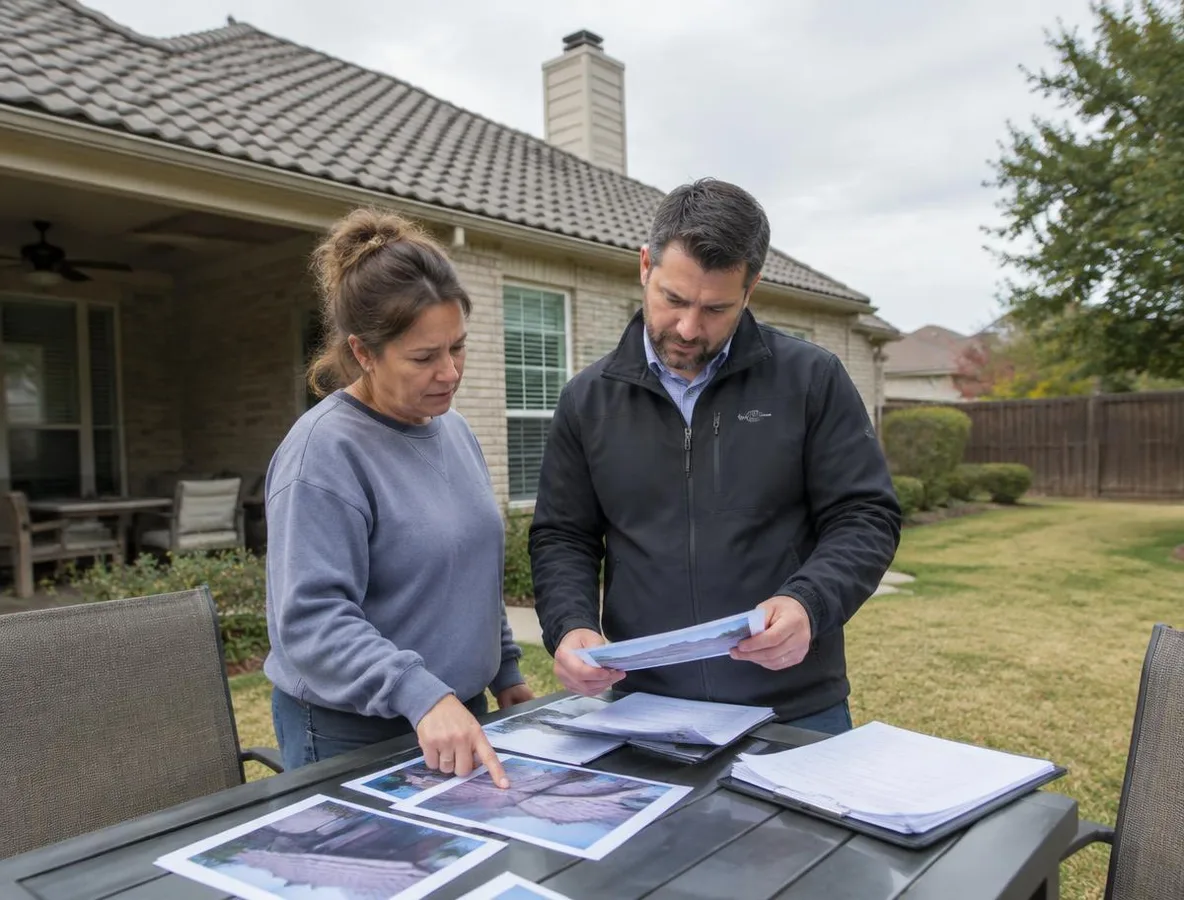
So you've got your photos from the morning after, you called it in, and now an adjuster is coming out. A tile roof claim tends to go a little differently than a shingle claim, because tile costs more per square and takes more labor to work on. Many of the line items that matter on tile don't show up on a shingle estimate at all.
Start with your policy before anybody gets on the roof. Pull out the declarations page and look at two things. First, does wind and hail have its own deductible, separate from the regular one? Plenty of Texas policies set it up that way. Second, does the policy pay replacement cost or actual cash value? Replacement cost generally pays what it takes to put the roof back.[1] Actual cash value takes depreciation off the top, and on a roof that's been up a while, that can be a big piece of the number.
When the adjuster walks the roof, be aware that tile can crack underfoot, same as it would for anybody else up there. If you notice new broken pieces after the inspection, take pictures of those too and mention it. That way they don't get blamed on the storm or left out of the estimate either way.
Once the estimate comes back, read it line by line. On tile, these are the things that tend to get missed or shorted:
- Underlayment. If the fix means lifting tile to get at a worn or punctured layer underneath, the estimate should cover new underlayment and the labor to pull the tile and set it back.
- Breakage. Some tile breaks when it gets lifted and stacked, especially older clay, so a lift and relay usually needs extra tile on hand beyond what the storm broke.
- Ridge and hip pieces. These are priced separately from field tile, and they're often the ones that took the hardest hits.
- Flashing. The metal at valleys, walls, and vent pipes can get dented or bent loose, and it doesn't always get counted unless somebody points to it.
- Matching. If your profile is discontinued, the estimate should say how that gets handled. Whether a policy pays to match across a whole slope varies, so ask your carrier directly.
If the estimate reads like it was written for an asphalt shingle roof, with no underlayment line, no breakage, and no mention of ridge tile, it probably needs another look. You can ask the carrier for a reinspection and send over your photos with a written list of what's missing. That's a normal part of the process, and it doesn't make you difficult.
The adjuster also has to settle whether a given crack came from this storm or from years ago. Your photos and the look of the breaks carry a lot of weight there.
Paperwork after the work matters too. We pull the permit in our name and schedule the final inspection, so the job is on record with the city. Carriers look at permit history when they process a future claim, and buyers look at it when you sell. A tile roof with a clean permit trail and storm photos behind it is a lot easier to stand behind the next time hail blows through Farmers Branch.
Know When Tile Roofing Is Not the Right Call
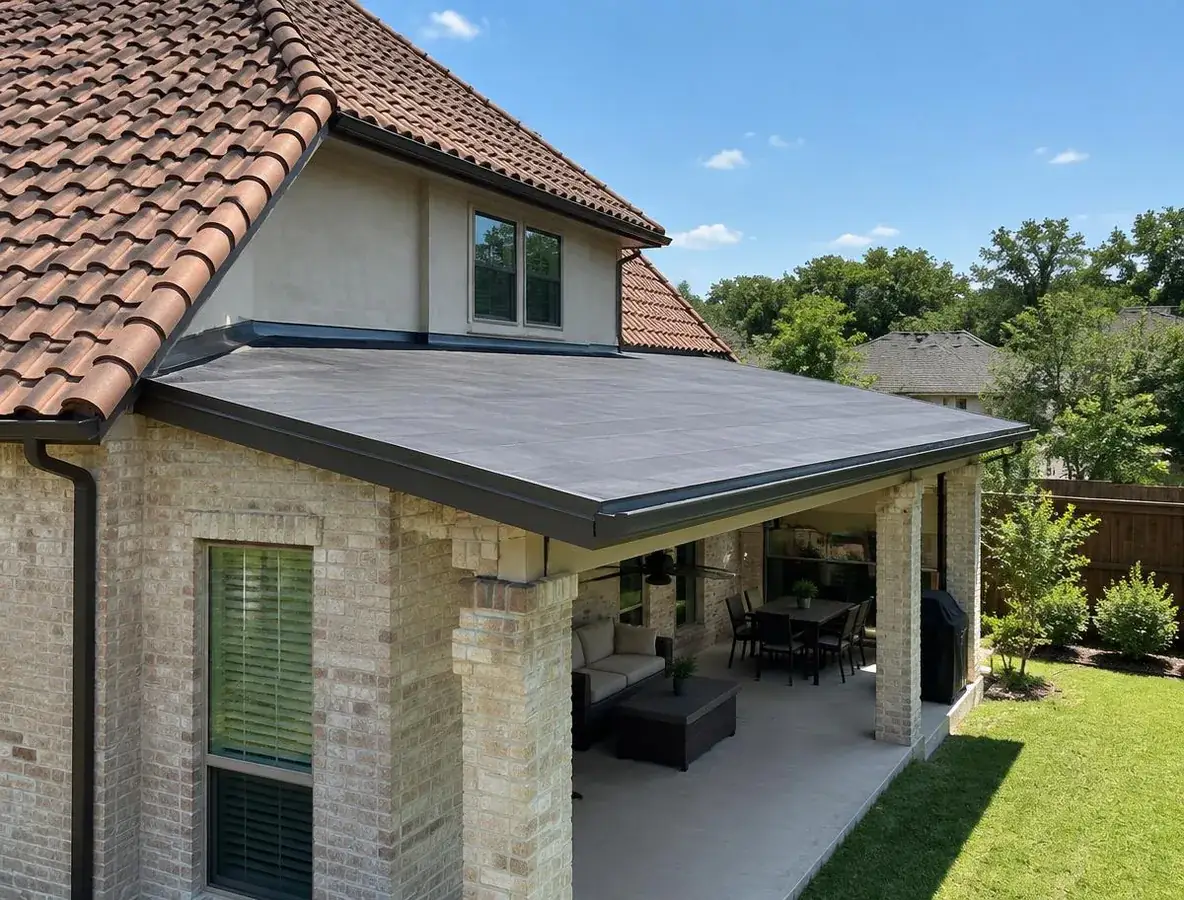
Tile looks great on the right house, and it can last a long time, but there are houses where it just doesn't make sense. You should know that before anybody starts talking color and profile with you.
Start with weight. Clay and concrete tile are a lot heavier than shingles, and a house that was framed for shingles wasn't necessarily built to carry that load. If you're going from shingles to tile, the rafters and decking have to be checked first. Sometimes that means a structural engineer looks at it and the framing gets beefed up. That adds cost before a single tile goes on. On some houses it isn't worth it.
Pitch is the next thing. Tile sheds water by overlapping, so it needs enough slope to run the water off before it can work its way back under. A low-slope roof, like a back patio cover or a flat section over an addition, generally isn't a good fit for tile no matter what the rest of the house has on it. Those spots usually get a different material, and that's normal.
Then there's what your neighborhood allows. Some HOAs and deed restrictions spell out which roofing materials and colors you can use, and some don't allow tile at all, or only allow certain profiles. Check that before you fall in love with a sample, because the city permit and the HOA approval are two separate things. Either one can stop the job.
A few other cases where tile tends to be the wrong call:
- Lots of foot traffic on the roof. If you've got solar panels, a satellite dish, rooftop HVAC, or vents that get serviced a lot, every trip up there is a chance to crack a tile, like the breakage mentioned above.
- You're adding a small section to a house that has another material on it. Putting tile on one wing so it doesn't match the rest usually looks off and costs more than it should.
- The budget is tight. Tile costs more per square for the material, and it takes more labor to put on and to work on later. If the money's going to be stretched, a well-installed shingle roof is the better roof.
- You're worried about hail more than anything. Tile can crack in a hard spring storm, the same as anything else up there. Clay and concrete hold up differently, and neither is hail-proof.
None of that means tile is a bad material. It means the house has to fit the roof, not the other way around. Our North Texas weather, with months of summer heat and hard spring storms, rewards a roof that suits the structure under it. A material that strains the framing or fights the pitch doesn't hold up as well.
If tile is out, you've got good options. Architectural shingles like GAF Timberline HDZ cover most houses well and cost less to maintain. Metal is light, sheds water on lower pitches, and handles wind well. We install shingle, metal, and clay and concrete tile, depending on the house and what the neighborhood allows, so there's no reason for us to push you toward one over another.
Have questions? We're happy to help.
(214) 649-5984What Happens During a Tile Roof Inspection and Repair
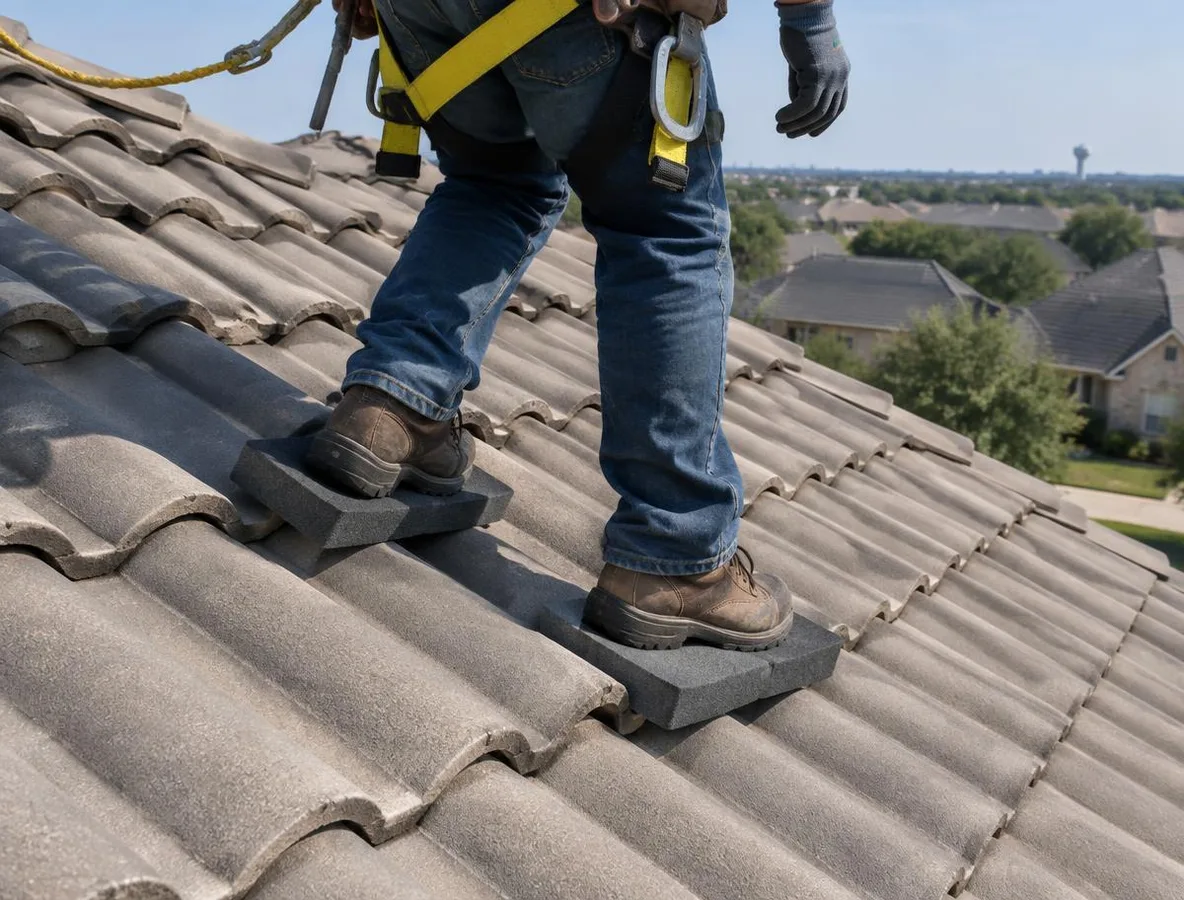
You've seen a cracked tile from the yard or a spot on the ceiling, and now somebody's coming out to get on the roof. A good tile inspection is slower than a shingle inspection, and it should be. How a roofer moves around up there decides whether they find damage or make more of it.
Tile has a right and a wrong place to step. A roofer who knows tile puts weight on the lower part of each tile, where it overlaps the one below and sits over the batten or the decking, and stays off the unsupported middle and the high points of a curved profile. Some use foam pads to spread the load. Somebody who walks it like a shingle roof is going to leave you with cracks that weren't there that morning.
Here's what a thorough look generally covers:
- Field tile, slope by slope, looking for cracks, chips, and tiles that slid out of line.
- Ridge and hip pieces, and whatever holds them down, whether that's mortar, foam, or fasteners. Loose ridge tile is one of the first things wind goes after.
- Valleys, where two slopes meet and the water runs heaviest. Leaves and grit can pile up there and back water up under the tile.
- Flashing at walls, chimneys, skylights, and vent pipes.
- The eaves, where closures keep birds and wasps from nesting under the first row.
- The attic, from the inside, checking for daylight, stained decking, or damp insulation under the spot that's leaking.
To check the underlayment, the roofer lifts a few tiles at the suspect spots and looks underneath. You can't judge it from on top of the tile. If nobody lifted anything, the inspection isn't finished.
Leaks on tile can be hard to trace, because water can run along the underlayment a good ways before it drips through. A stain over the dining room can come from a cracked tile right above it, or it can come from a clogged valley six feet uphill. You usually don't know until somebody lifts tile along the path and follows it.
The repair itself is mostly careful hand work. To replace a broken tile, the tiles above it get eased up, the broken piece comes out, and any nail holding it gets cut or pulled. The new tile slides into place and gets secured, usually with a tile hook, a fastener, or a roof-rated adhesive, depending on how the roof was built. A worn spot of underlayment gets patched and lapped the right way so water runs over the seams instead of into them, and loose ridge pieces get reset. A small repair with a few tiles can often be done in a single visit, as long as the right tile is on hand.
When it's done, you should get photos of each spot that was fixed, from before and after, and a plain list of what was replaced and where. Ask to keep any leftover tile. Stack it in the garage or the side yard, because the next time hail blows through Farmers Branch in April, a few matching spares can turn a hunt for discontinued tile into a quick swap.
Concrete Tile Roof Work in Preston Hollow
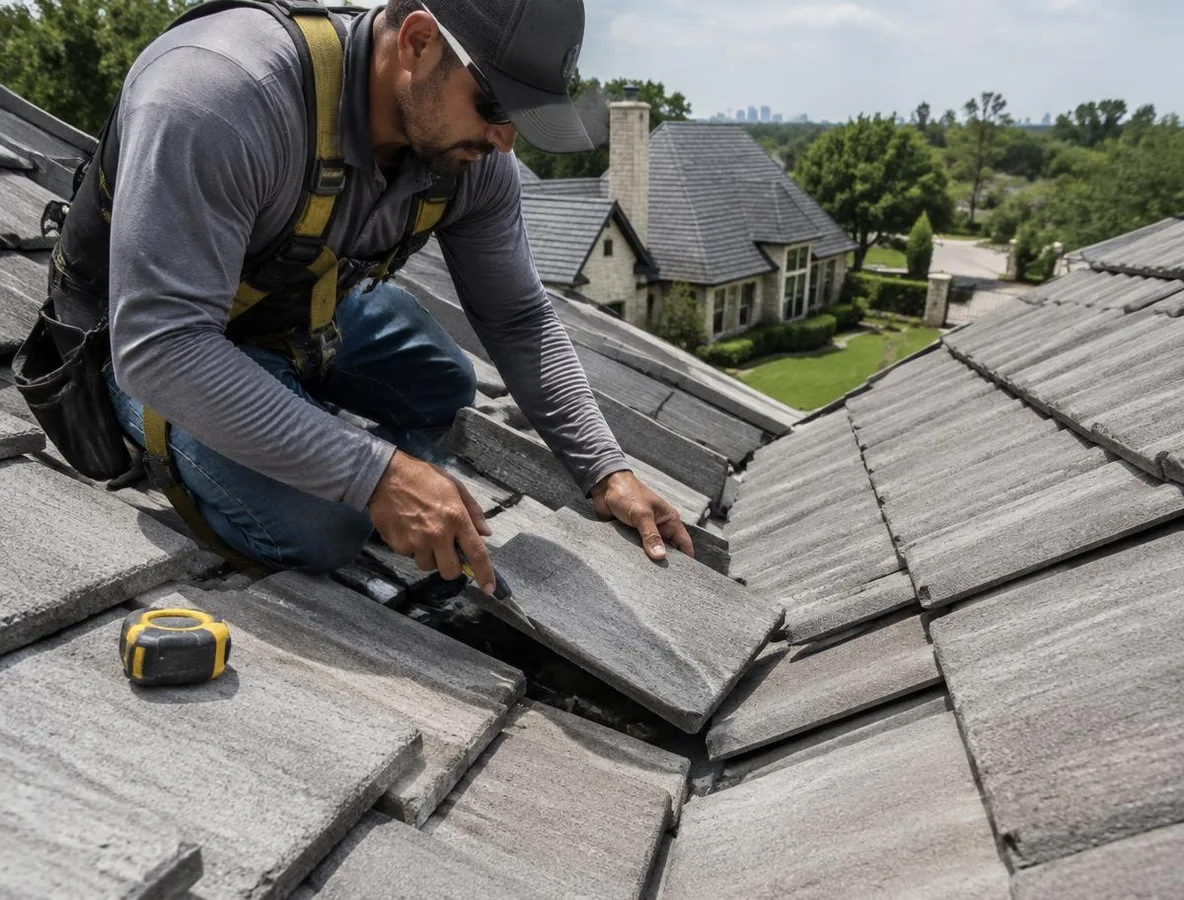
This summer we were on a concrete tile roof in Preston Hollow, cutting new tiles to fit. Tiles at the edges, valleys, and hips rarely drop into place straight off the pallet. Each piece gets measured and cut so it sits tight and sheds water like the rest of the roof. You can watch those cuts in the video below.
That same care goes into the tile jobs we take on from Preston Hollow to Carrollton and the Dallas-Fort Worth area.
Frequently Asked Questions
What are the downsides of a tile roof?
Tile costs more upfront and adds weight your framing has to be able to carry. It also takes more labor to install and to work on later, so repairs after hail or foot traffic cost more than they would on shingles. Clay and concrete handle those risks differently, but neither is hail-proof or immune to cracking from someone walking on it the wrong way. For a lot of houses, tile is still worth it, but you should weigh these trade-offs before you commit.
Can a few cracked tiles mean the whole roof is failing?
Not usually. A handful of cracked or slipped tiles over sound underlayment is typically a simple repair, not a sign the whole roof is going bad. The bigger concern is what's happening underneath the tile, since the underlayment wears out faster than the tile itself in our North Texas heat. A proper inspection lifts a few tiles to check that layer directly instead of guessing from what's visible on top.
Why do roof tile colors or profiles sometimes not match after a repair?
Older tile profiles and colors get discontinued over time, so a repair years after the original install can mean the new tiles don't quite match. One option is pulling good tiles from a hidden slope, like the back of a garage, and using them where the patch will show. If you've had tile work done before, keeping any leftover tiles on hand gives you matching spares for the next repair instead of starting a search from scratch.
Do you install clay tile, concrete tile, or both?
We install, replace, and repair both clay and concrete tile. Clay tends to crack clean through, while concrete is heavier and more likely to chip. We work on tile roofs from Preston Hollow to Carrollton and the Dallas-Fort Worth area.
Is it safe to walk on a tile roof?
Only if you know where to step, so it's best to stay off it. Tile can crack under one wrong step, even on a healthy roof. We put weight on the lower part of each tile, where it overlaps the one below.
Why does the underlayment matter more than the tile?
The underlayment is what actually keeps water out, and it usually wears out before the tile does. Months of North Texas summer heat dry it out and make it brittle. That's why we lift a few tiles to check it instead of judging the roof from the top.
Ready for Your
Tile Roofing?
Get a free, no-obligation evaluation from our GAF certified team in Farmers Branch. We'll inspect your property, provide a written estimate, and walk you through every option.
Want to pay over time? Check your financing options.


Need A Roofing Contractor? Request An Estimate!
Fill out the form and we'll get back to you promptly.