

Slate Roofing in Farmers Branch: Repair or Full Replacement
Trusted roofing across Dallas-Fort Worth, done right the first time.
- GAF Certified Contractor
- BBB Accredited, A+ Rating
- 24/7 Emergency Roof Repair
- Family Owned and Local
We install and repair slate roofs in Farmers Branch and across Dallas and the surrounding area, both natural stone and synthetic. It's one part of our residential roofing work, and it takes a different touch than a shingle roof.
Slate Roof Repair Versus Full Replacement: How The Decision Gets Made
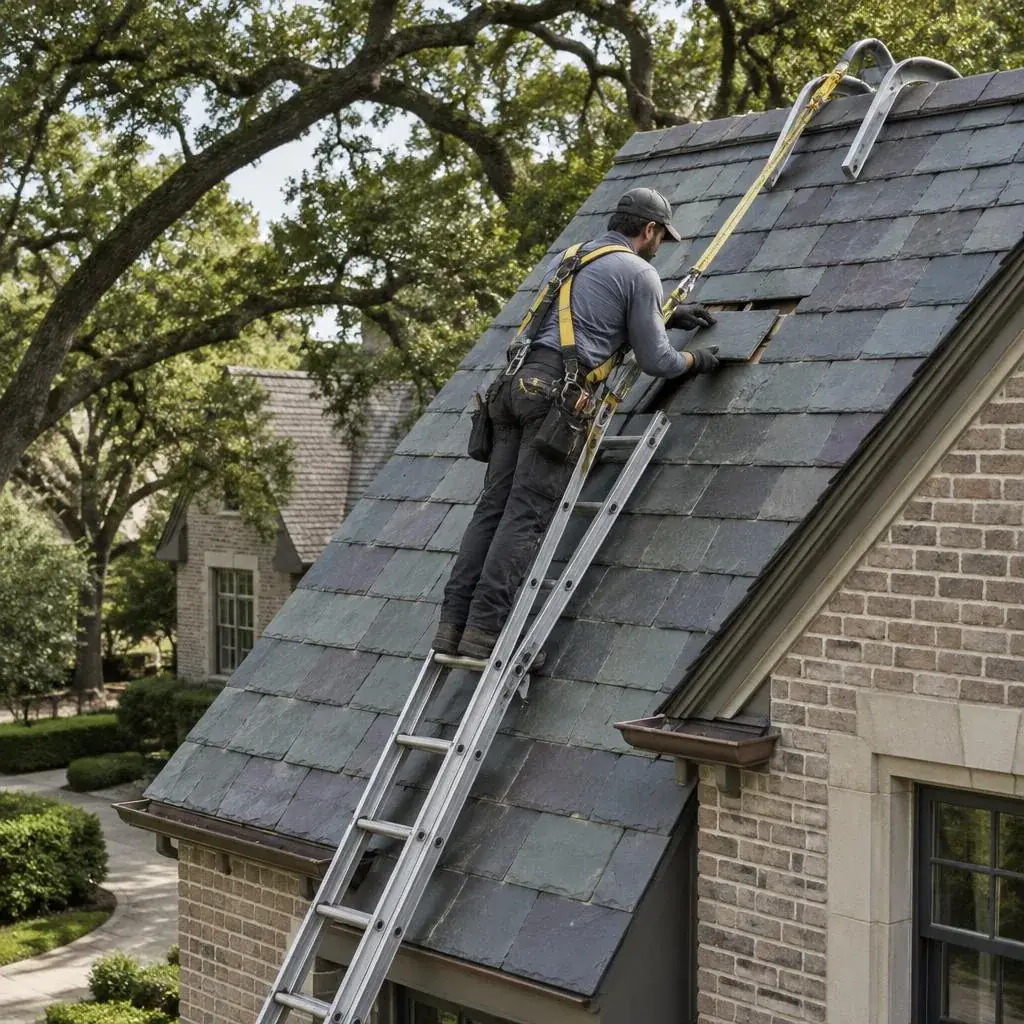
Most slate roofs don't fail all at once, so the decision comes down to what's wearing out: the stone, the nails holding it, the flashing, or the layers under it. If the slate is still sound and the problems are spread thin, a repair usually makes sense. If the fasteners or the underlayment are done across the whole roof, patching one spot just moves the leak somewhere else.
Say you've got a water stain on a bedroom ceiling after a storm blew through, or you can see a couple of slates hanging crooked from the driveway. The first instinct is to assume the whole roof is going. Many times it isn't, because good slate can outlast just about everything else on the house, and the stone is usually the last thing to give out.
That leak could be one cracked slate letting water through, or it could be flashing around a chimney or along a valley that has worn thin. From the ground you can't tell which, and you don't know until somebody gets up there and traces it.
So the decision really sits on four things, and a roofer should look at all four before saying repair or replace:
- The slate itself. Is it hard and holding up, or is it flaking, soft, and breaking when it gets handled? Sound stone can usually be kept.
- The fasteners. A slate roof can lose its nails before it loses its stone. When the nails rust through, slates start slipping out of place even though the slate is fine. If that's happening all over the roof, it's a roof-wide problem.
- The flashing. Valleys, chimneys, and wall lines are where water tends to get in. Flashing can often be redone without replacing the field of the roof.
- What's underneath. If the underlayment has dried out and the decking is soft in spots, no amount of slate work up top will fix that.
A repair on slate is a careful, piece-by-piece job. The broken slate comes out and a matching one goes in, and the hard part is usually finding stone that matches in color, size, and thickness. The more slates that need swapping, the more that matching starts to matter, and the more the work starts to cost like something bigger.
Replacement starts to make sense when the problems aren't in one spot anymore. If slates are slipping on every slope because the nails are gone, or the stone is breaking down across the whole roof, then patching just chases leaks around. A full redo also means going all the way down to the decking, because that's the only way to see if it's still solid enough to carry a slate roof. It has to be nailable, not rotted.
Our North Texas hail adds one more wrinkle. A storm can crack slates on one slope and barely touch another, so a hail claim on a slate roof isn't always all or nothing. It depends on how many slates broke and where.
One thing to watch for: slate breaks when people walk on it wrong, so an inspection by someone who doesn't know slate can cause the very damage they write up. Anybody who tells you to tear off a slate roof without checking the nails, the flashing, and the decking first is guessing. If someone tells you it all has to come off, ask them to show you exactly where and why.
Signs A Slate Roof Needs Professional Attention

Most of the time a slate roof tells you something's off well before water shows up inside, and you can catch a lot of it from the driveway or the attic without ever getting a ladder out. Since slate cracks underfoot, which we covered above, the ground is the right place to look from. A cheap pair of binoculars helps more than you'd think.
Here's what to look for from the yard:
- A slate sitting lower than the ones beside it, or hanging crooked. That usually means it's come loose and is on its way down.
- A gap in the pattern where a slate used to be. Look closely and you'll see a darker strip of whatever is underneath showing through.
- Pieces of slate in the gutters, the flower beds, or on the driveway after a windy night.
- Corners snapped off or a crack running across a slate, especially on the slope that faces the storm after spring hail.
- Slates that look flaky or chalky, or that are peeling apart in thin layers at the edges.
- Black tar or caulk smeared over slates or along a chimney. That's a sign somebody patched it the quick way, and it can hold water in place instead of shedding it.
Then go up in the attic on a bright afternoon and turn the light off. Pinholes of daylight coming through, dark rings on the decking, or stains running down a rafter all mean water's been finding a way in. Check close to the chimney and anywhere two slopes meet, because those spots tend to show it first.
Inside the house, a ceiling stain that grows a little after every rain is the one to take seriously. It can be a single broken slate a few feet uphill from the stain, or it can be flashing that's pulled away from a wall. Water travels along the decking before it drips, so where you see it isn't always where it starts. You don't know until somebody gets up there and traces it.
Our North Texas weather is part of the timing too. Months of summer heat dry out the layers under the slate, and then the spring storms bring hail and the kind of wind that finds any slate that's already loose. One slipped slate in June can turn into three missing ones by April.
So which signs can wait and which can't? A single slate that's slid an inch, no stain inside, nothing wet in the attic, that's something to get looked at soon, not tonight. Water dripping through a ceiling, a whole row of slates gone after a storm, or daylight showing through in more than one spot is different. Water that's actively coming in keeps soaking the decking and the drywall the whole time it sits.
If all you've got is a slate or two lying in the yard after a windy night, it's fine to have someone check it. Many times it's a small fix, and catching it early is what keeps it that way.
When A Slate Roof Does Not Need Replacement
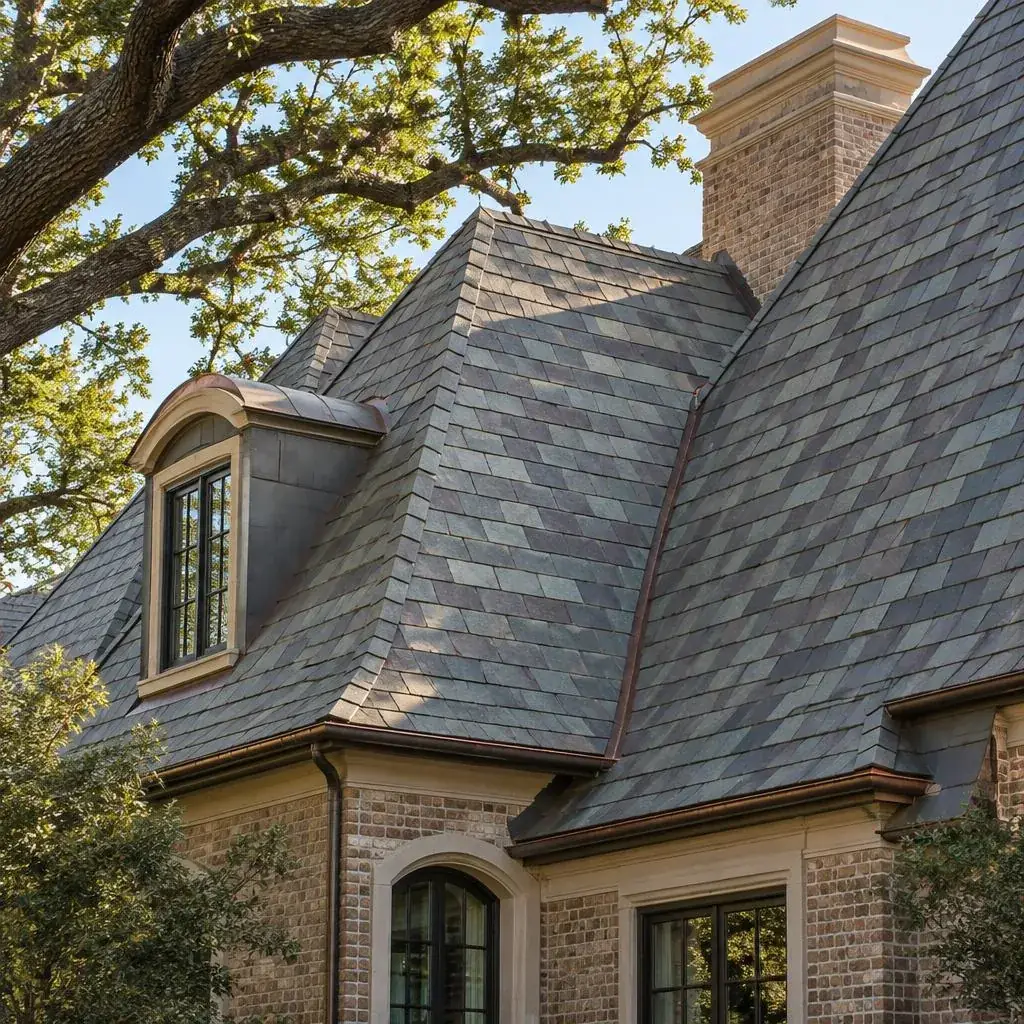
A lot of slate roofs that get written up for replacement don't need it. The person doing the writing up may be used to shingle roofs, where a roof of a certain age is usually close to done. Slate doesn't work on that clock, so the old rules of thumb tend to steer people wrong.
These are the cases where a full new roof usually isn't the answer:
- The roof is just old. Age by itself isn't a reason to tear off slate. If the stone is hard and the nails are holding, an old slate roof can keep doing its job for a long time yet.
- The color has changed. Some slate fades or shifts color as it weathers, and a patchy look from the street is cosmetic. It doesn't mean water is getting in.
- Hail cracked a handful of slates. Broken pieces get pulled and swapped one at a time, and the rest of the roof stays put.
- Someone smeared tar over a few spots years ago. That old patch work can be cleaned off and done properly with real slate and real flashing. It doesn't mean the whole roof has failed.
- The leak traces back to flashing. Redoing a chimney or valley is a fix for that spot, not a reason to strip the slopes around it.
There's also a middle option that people don't always hear about. Say the slate is good but the underlayment under it has dried out across a whole slope. The other option to a full replacement would be to take the slates off carefully, set the sound ones aside, fix what's underneath, and lay the same stone back down. You'd add matching slate only where pieces broke or were already gone.
It's more careful work than a tear-off, and it doesn't fit every roof, because some slate gets brittle enough that too many pieces break coming off. But when the stone can handle it, you keep the roof you've got and only fix the part that's worn out.
Not every roof that looks like slate from the driveway is real stone. Synthetic slate is made from other materials, and it wears, ages, and gets repaired differently. We work on both, but if you're not sure what's on your house, find that out first, because it changes the whole conversation.
Some things you can just leave alone for now. A little lichen on the north slope, a slate that's a shade off from its neighbors, a small chip on a corner with nothing wet in the attic below it: none of that needs a crew this week. Keep an eye on it after the spring storms roll through and look again from the ground.
So if your slate is mostly solid and the trouble is in one or two places, you're probably looking at a repair, and maybe not even a big one. A full replacement is for roofs where the stone, the nails, or what's under them have given out across the whole roof. A roof that's simply old, faded, or nicked doesn't meet that bar.
Why Slate Roofing Requires Different Handling Than Asphalt
A lot of roofers in Dallas and the suburbs around Farmers Branch spend most of their days on asphalt, and that's fine, because asphalt is most of what's up there. Slate works on a different set of rules, though, and the habits that make sense on architectural shingles can do real harm on stone.
Start with weight. Slate is heavy, generally several times heavier per square than asphalt shingles, and a square is just 100 square feet of roof, the unit roofers use so the math stays simple. So the framing under a slate roof has to be built to carry it. That matters most when someone wants to put slate on a house that was framed for shingles. Then it's a structure question first and a roofing question second.
Then there's how the stone gets fastened. A shingle gets nailed down snug, and that's the whole idea. Slate is different. Each slate usually hangs on its nails, set just right, because a nail driven too tight can crack the slate right then, or it can crack later when the stone moves a little with the heat. Driving the nail too loose causes its own trouble, since the slate can rattle and work itself free in the wind. It takes a feel for it.
Slate roofers also tend to use copper or stainless steel nails, and the reason is simple. The stone can last far longer than a plain steel nail. When the nail gives out first, the slate slides off even though the slate itself is fine.
That same thinking carries over to the flashing and the layers underneath. On an asphalt roof, everything wears out on roughly the same schedule, so standard metal and felt make sense. On slate, cheap flashing in a valley or around a chimney can wear out long before the stone does. Then the roof has to be opened back up around good slate just to fix the cheap part. Many slate roofers reach for copper flashing for that reason.
Repairs follow different steps too:
- On asphalt, you lift the shingle above, pull a few nails, and slide a new one in.
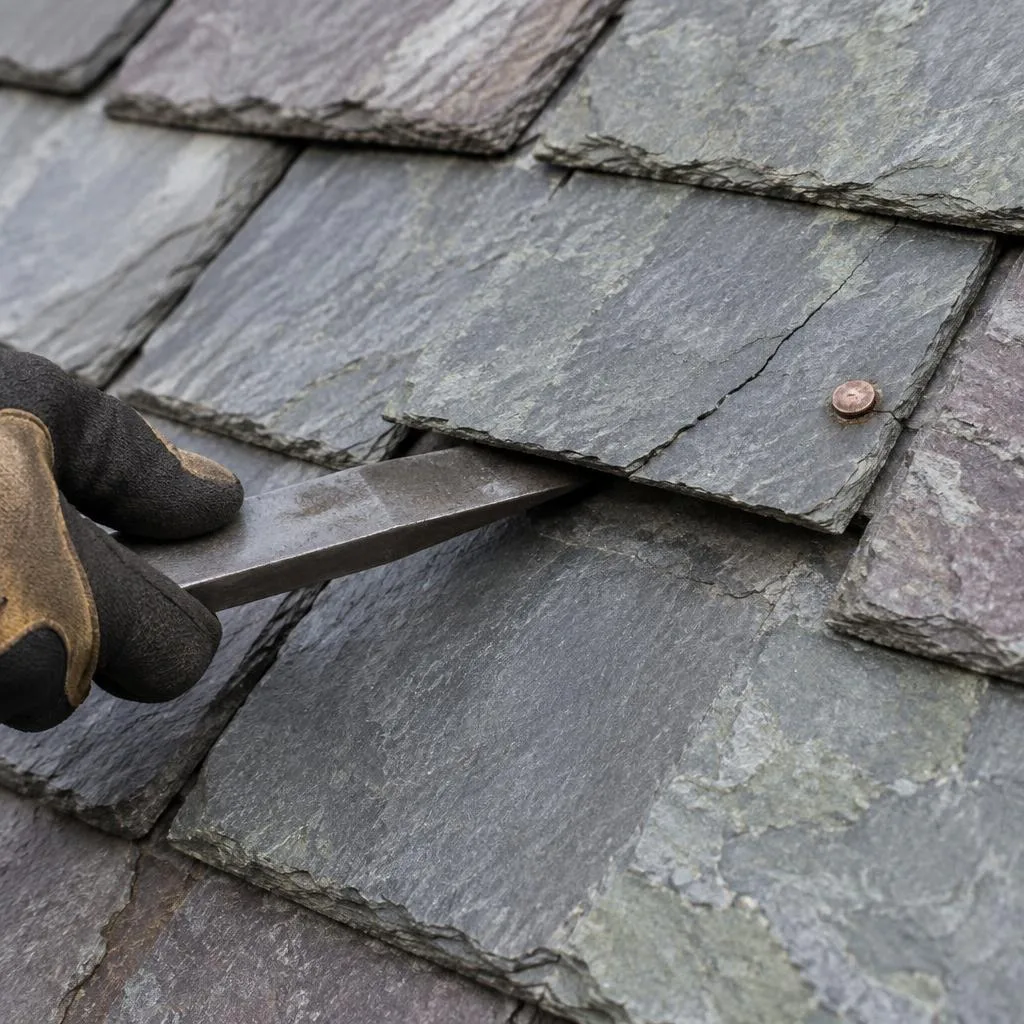
- On slate, the broken piece usually gets cut loose from its hidden nails with a slate ripper, a long flat tool that reaches up under the course above.
- The new slate then goes in with a method that holds it without driving a nail through the good slate overlapping it.
- Tar, roof cement, and shingle-style patching don't belong in that process at all.
Our North Texas heat plays into all of this. Slate itself shrugs off August, but the underlayment beneath it sits through months of that heat with stone baking on top. That's part of why the layers under a slate roof can wear out while the slate looks the same as the day it went up. It can be a hidden underlayment problem, or it can be a flashing problem at the wall line, and you won't know which until somebody who knows slate gets up there and looks.
Slate is part of what we work on in Farmers Branch and across Dallas and the surrounding area, along with shingle, metal, and tile, depending on the house and what the neighborhood allows.
Natural and Synthetic Slate Installation
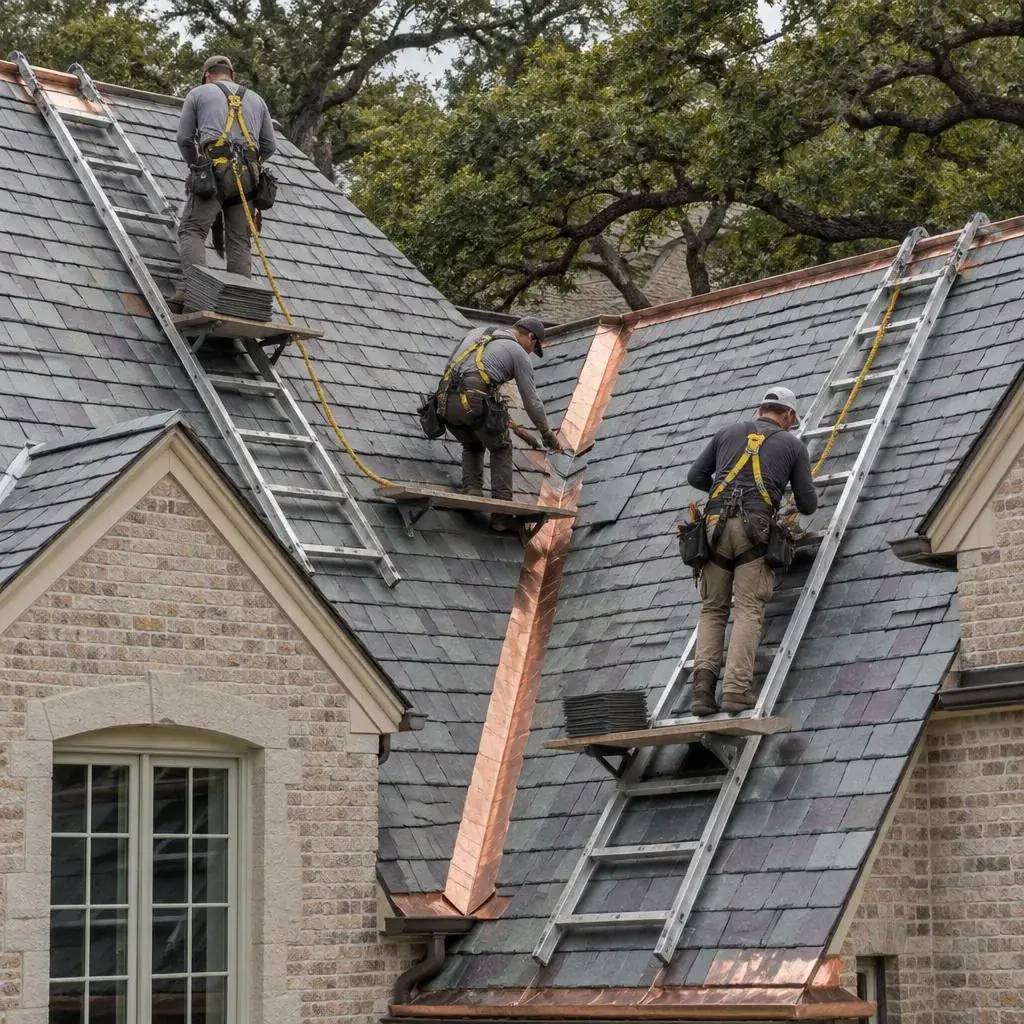
We install both natural slate and synthetic slate on homes in Farmers Branch and across Dallas and the surrounding area. Which one fits comes down to the house, the budget, and what the framing can carry.
Natural slate is real stone. It's heavy, it costs more up front, and on the right house it can outlast just about everything else on the roof. Before it goes on, the framing has to be checked, because a house built for shingles may not be built to carry stone. That's a structure question first and a roofing question second.
Synthetic slate is made to look like stone from the street, and it weighs a lot less. That can put the slate look within reach on a house whose framing wasn't built for real stone, and it's usually easier on the budget. It usually doesn't last as long as natural slate, though, and it gets repaired differently.
Either way, a new slate roof starts the same as any roof we put on. We tear off down to the decking, check that the wood is solid and nailable, and fix what isn't before anything new goes down. We pull the permit in our own name and schedule the final inspection.
What Happens During A Slate Roof Inspection And Repair
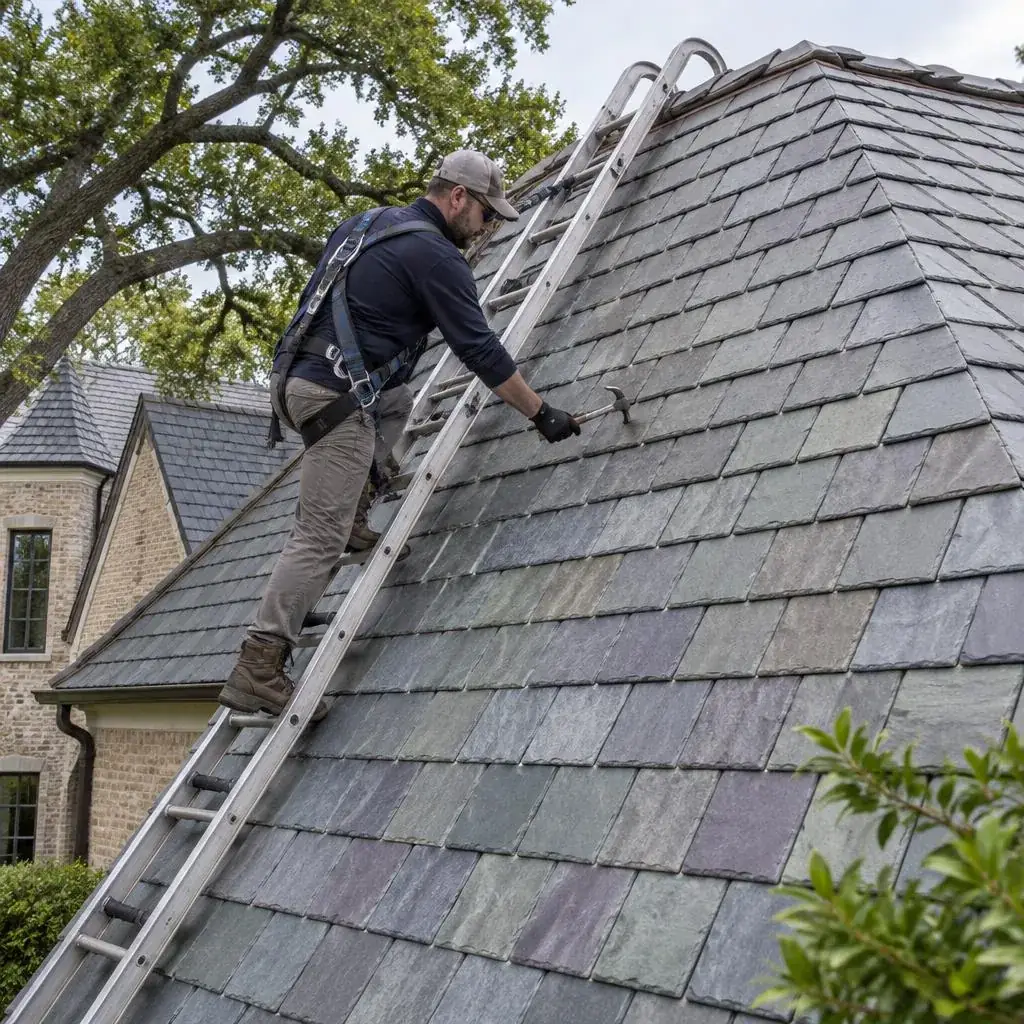
A good slate inspection usually starts on the ground and in the attic instead of on the roof, because slate is a lot easier to break than it is to read. From the yard you can count the slipped and missing pieces and mark which slopes took the hail. Then from the attic you can see where water's been running on the decking, and that narrows down where somebody needs to go up.
Getting on the roof is where slate work splits from shingle work. On a shingle roof, a roofer just walks it. On slate, the usual way to move around is on a roof ladder hooked over the ridge, or on hooks and planks, so your weight sits on the ladder and not on the stone. Somebody walking across your slate in work boots is probably adding to the list of broken pieces.
Once they're up close, these are the things a roofer who knows slate tends to check:
- How the stone sounds. Sound slate gives a clear ring when it's tapped, and soft or flaking slate gives a dull thud. That tells you more than looks do.
- Why the slipped slates slipped. Either the nail rusted through, or the slate broke at the nail hole. Those are two different problems.
- The flashing at the chimney, the valleys, and the wall lines, looking for holes, open seams, and old tar.
- Past repairs, like mismatched stone, metal tabs showing, or caulk where there shouldn't be any.
- How many slates are broken on each slope, since that count drives the whole repair.
That ceiling stain doesn't always point to one answer, either. It can be a cracked slate up near the ridge, or it can be a pinhole in a valley that's been seeping for years, and sometimes it's both. Good inspectors don't settle on the first broken slate they find.
What you should get back is plain and specific. You want to know which slope, how many slates, what's going on at the flashing, and photos of each spot. The list should be split into what needs fixing now and what can be watched. Anybody who hands you a number without that is guessing.
With us, Max, who owns the company, works the jobs alongside the crew. So the person who looked at your roof is the same one standing there when the repair gets done, and the details from the inspection don't get lost between a salesperson and a crew.
Repair day depends a lot on the weather. Wet slate is slick, and our North Texas spring can bring storms through every few days, so the work generally waits for a dry stretch. The broken pieces come out the way we covered above, matching stone goes in, and any bad flashing gets redone. How soon that happens mostly comes down to the stone. A common size and color can be easy to find, but an odd one can take some hunting.
If water's coming in right now, the leak gets covered first and the slate work comes after. Emergency roof repair is available nights and weekends for that reason.
Afterward, go up in the attic after the next good rain and look at the same spot. If it's dry, the fix held. If that stain keeps growing, it was the other cause, and it's time to have someone trace it again.
Frequently Asked Questions
Can any roofer repair a slate roof, or do I need a specialist?
You need someone who knows slate, not just a general roofer. Slate cracks easily underfoot, so walking it wrong can create new damage during the very inspection meant to find problems. A roofer experienced with slate moves around on a roof ladder or hooks and planks instead of walking directly on the stone, and checks the sound of each slate, the nails, and the flashing before suggesting any fix.
Is it normal for only part of my slate roof to be damaged after a hailstorm?
Yes, this is common with slate roofs in North Texas. A storm can crack slates on one slope and barely touch another, so hail damage often isn't spread evenly across the whole roof. That's why a repair decision usually depends on counting broken slates slope by slope, rather than assuming the whole roof needs attention.
Can mismatched or discolored slate be a sign of a bigger problem?
Not usually. Slate can fade or shift color as it weathers, and that patchy look from the street is typically cosmetic, not a sign water is getting in. The slates worth worrying about are ones sitting lower than their neighbors, hanging crooked, or missing altogether, since those point to a nail or fastening problem instead.
What should I do if I find slate pieces in my gutter or yard after a storm?
Have it checked soon, but it doesn't need to be treated as an emergency if there's no water coming in. A slate or two on the ground after a windy night is often a small, isolated fix rather than a sign the whole roof is failing. Check your attic on a bright day for any pinholes of light or stains on the decking, since that tells you whether water has started getting in.
Do you install new slate roofs?
Yes, we install both natural slate and synthetic slate. Natural slate is real stone and a lot heavier, so the framing gets checked first. Synthetic slate weighs less and usually costs less, which can make the slate look work on a house that wasn't framed for stone.
Can slate go on a house that has a shingle roof now?
Sometimes, but the framing has to be checked first. Natural slate is a lot heavier than asphalt shingles, so a house framed for shingles may need reinforcing before it can carry stone. Synthetic slate is lighter and is often the easier fit.
Ready for Your
Slate Roofing?
Get a free, no-obligation evaluation from our GAF certified team in Farmers Branch. We'll inspect your property, provide a written estimate, and walk you through every option.
Want to pay over time? Check your financing options.


Need A Roofing Contractor? Request An Estimate!
Fill out the form and we'll get back to you promptly.